Rhine fuel freight hits €215
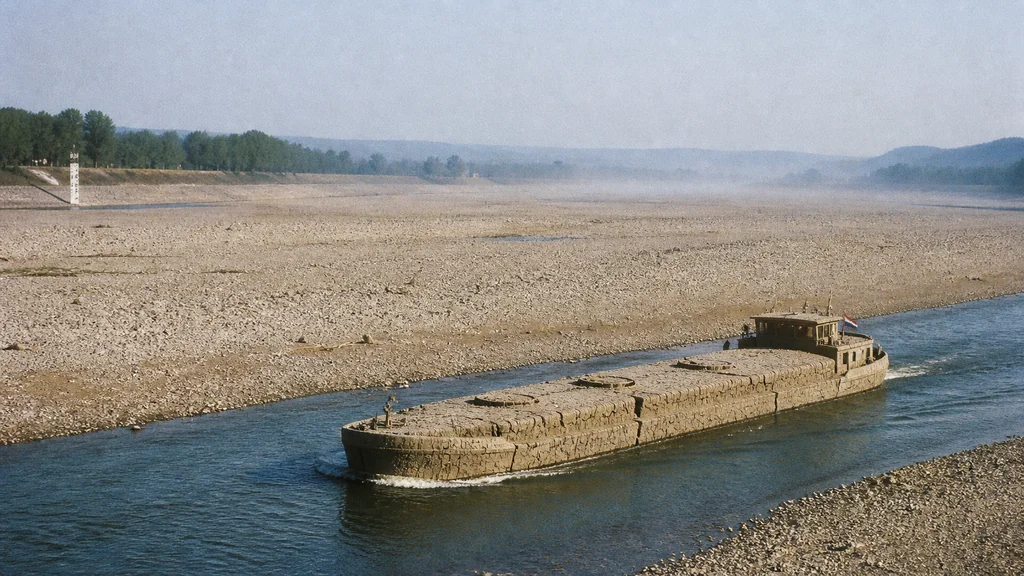
The Rhine remains open, but its carrying power has vanished.
Kompożizzjoni tal-immaġni · tobriefA fuel barge sailing from Rotterdam towards Strasbourg this week loaded about 350 tonnes of petrol instead of the usual 1,500-plus (DHNet/AFP). That is less than a quarter of capacity, on a river that has not been formally closed. The captain still sailed. By then, the economics had already made the decision.
By Thursday, around a third of petrol stations in Alsace were missing at least one fuel grade (TF1). In the wider Grand Est region, about 14% of forecourts reported supply problems, according to France's fuel-price monitoring portal (prix-carburants.gouv.fr). The pattern matters. SP95 and SP98 petrol usually reach eastern France by Rhine barge, while diesel more often comes by pipeline. The Bas-Rhin prefecture confirmed that split (DHNet/AFP). That is why Alsace can be short of petrol while diesel remains available.
One gauge reading, basin-wide collapse
Fuel for eastern France usually starts around Amsterdam, Rotterdam and Antwerp, the trading cluster known as the ARA hub. Barges then move it up the Rhine into Germany, Switzerland and France. The pinch point is Kaub, in Germany's Rhineland-Palatinate. On Friday evening, its gauge read 6 cm, with forecasts putting it at 5 cm by Saturday (Tagesschau, n-tv). That reading is not the river's depth. It is a reference level used by shippers. Six centimetres still leaves about 130 cm of navigable channel, but Germany's inland shipping association treats single-digit Kaub readings as the point where regular commercial traffic stops making practical sense.
The effect is brutal in logistics terms. A vessel rated for 1,200 tonnes could carry only 180 tonnes through Kaub (Argus). Rhine freight volumes to and from Rotterdam were more than 10% below normal, with ships loaded at 30–35% instead of the usual 70% (WNL). At Lobith, where the Rhine enters the Netherlands, water flow fell to 614 cubic metres per second, below the previous record set in 1947 (DutchNews).
Spot freight rates on the ARA-to-Karlsruhe route reached a record €215 per tonne, from about €45 in late June (Argus). But with so few cargoes moving, the quoted price says more about desperation than actual available capacity.
Rail and road can't replace the river
Storage terminals at Strasbourg-Reichstett are shifting part of their supply from barges to rail tank cars (DNA). The scale does not match. One 3,000-tonne inland vessel replaces roughly 150 lorries (ingenieur.de). Trans.info reported industry estimates putting missing transport capacity at 50–75%, or around 250,000 truckloads a month (trans.info).
Germany has suspended Sunday truck bans to open more road capacity. But a Sunday exemption does not create drivers, and it does not remove EU rules on rest times. Rail has its own bottleneck. Kuehne+Nagel warned that track works between Troisdorf and Wiesbaden are disrupting the same corridor's rail network (Kuehne+Nagel).
Who pays for the water that isn't there
French drivers are meeting empty pumps in August. German industry is dealing with broken delivery commitments: BASF declared force majeure, a legal notice saying exceptional conditions prevent normal deliveries, on several product lines from its Ludwigshafen complex (Breakbulk, Insurance Journal). In Belgium, Flemish construction firms that need Rhine sand now send a barge four times for the same load, paying surcharges of €8/t for sand and €17/t for gravel (GVA). Dutch barge operators are caught between rising surcharges and lower revenue from underloaded voyages (Scheepvaartkrant).
Luxembourg's fuel prices also rose this week, with diesel up 10.6 cents to €1.904/l and SP95 up 7 cents, but no source linked the increase to the Rhine and no shortages were reported (Chronicle, RTL Today). Luxembourg sets fuel prices on a weekly schedule, so these look like normal adjustments rather than Rhine-driven contagion.
For Malta, the lesson is familiar even if the geography is not. A supply route can fail before anyone officially closes it, and small shifts in freight capacity can become retail shortages with little warning. The Rhine is still open on paper. In commercial terms, it has stopped carrying enough. Until the water rises, eastern France is buying fuel security with more vehicles, more trips and far less certainty.
Details about this article
- Model:
- claude-opus-4-6
- Generated:
- 8/15/2026, 1:59:57 AM
- Pipeline run:
- eu_pipeline_20260815_005006
- Watermark:
- SynthID (Google's invisible watermark)
- Human review:
- None before publication