Rhine Low Water Drives Up Freight
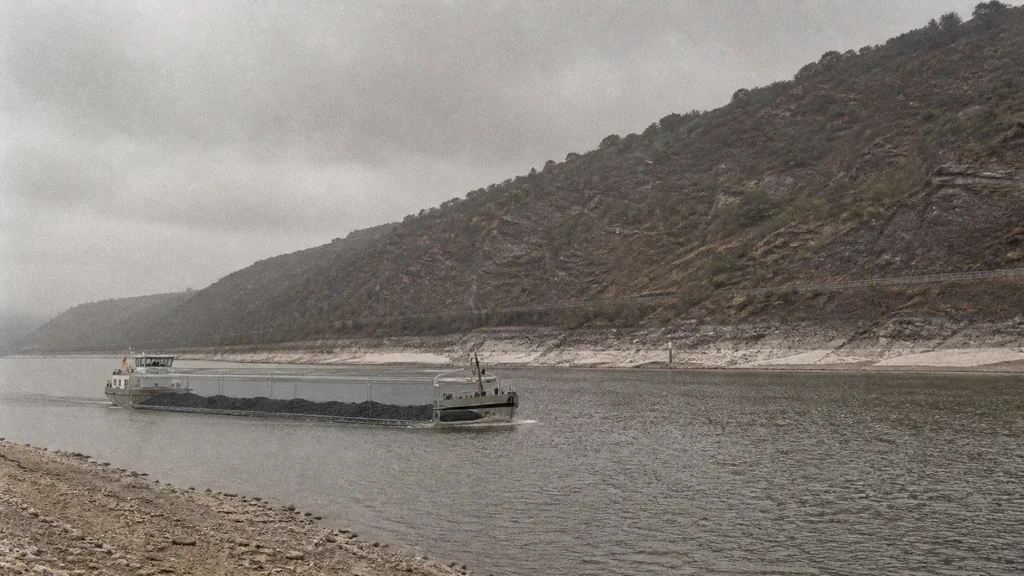
Europe’s busiest river carries more emptiness with every passing vessel.
Kompożizzjoni tal-immaġni · tobriefA barge passing Kaub on the Middle Rhine this week is carrying about a third of the cargo it was built for. The gauge at this bottleneck between Koblenz and Mainz is reading around 16-17 cm, below the previous record low of 25 cm set in 2018 (ELWIS, Tagesschau). That figure is often misunderstood. It is not the full depth of the Rhine, but the height above a fixed reference point, and it determines how deep a loaded vessel can sit in the water.
The result is simple enough: Europe’s busiest inland freight corridor is still open, but it is moving much less cargo at a much higher price. For Malta, which sits at the far end of European supply chains and imports nearly everything it consumes or processes, these inland bottlenecks matter even when they happen hundreds of kilometres from the nearest port we use.
The Port of Rotterdam is seeing around 100 extra vessel calls per week, yet total Rhine traffic remains more than 10% below normal (nieuws.nl). More ships are being used to move less freight.
How depth becomes cost
The mechanism is physical before it is economic. Each 10 cm of lost depth removes roughly 100 tonnes of carrying capacity from some vessels, Dutch operators told Trouw (Trouw). At Luxembourg’s Mertert port, barges designed for 2,000 tonnes were loading just 450-500 tonnes (RTL Infos). Vessels linked to Rotterdam that would normally load at about 70% are down to 30-35% (Schuttevaer, Transport Online).
Prices are following the water level. Shipping one tonne from Rotterdam to Karlsruhe now costs roughly €150-160, up from about €45 in late June (RFI, Breakbulk).
Why trucks and trains cannot fill the gap
A single 3,000-tonne barge replaces roughly 150 trucks (ingenieur.de). German Federal Transport Minister Steffen Bilger has pushed five German states to relax Sunday truck bans for replacement freight (Zeit). But the lever is weaker than it looks. As BGL’s Dirk Engelhardt noted, drivers working Sundays still fall under EU rest-time rules. A Sunday shift must be offset by rest on other days, so the system does not gain extra driving hours overall (ingenieur.de).
Rail is not a clean substitute either. A key Rhine corridor is closed for scheduled maintenance, Kuehne+Nagel warned clients (Kuehne+Nagel). A Czech logistics expert put it plainly to iROZHLAS: full substitution is practically unavailable (iROZHLAS).
Who pays
The Rhine links Rotterdam and Antwerp to chemical plants in Ludwigshafen, steelworks in the Ruhr, and factories extending into Switzerland. These are not marginal flows. Inland waterways carry the bulk goods on which German manufacturing runs: petroleum products, ores, chemicals and construction materials (Eurostat, Destatis). BASF’s Ludwigshafen complex, Europe’s largest integrated chemical site, depends heavily on Rhine logistics (C&EN).
The pressure is not confined to Germany. Where the Rhine enters the Netherlands at Lobith, inflow has fallen to around 614-615 m³/s, about a third of the normal 1,800-1,900 m³/s (NRC). In Belgium, Flemish construction firms say a barge that would normally carry 3,500 tonnes of Rhine sand now loads about 900. Low-water surcharges have reached €8 per tonne for sand and €17 for gravel (GVA).
Kiel Institute economist Stefan Kooths estimates that the episode could cut 0.1-0.2 percentage points from German GDP in Q3, or roughly €1-2 billion in lost output (Tagesschau). The estimate is provisional, but the order of magnitude is credible when so much industrial throughput depends on one river system.
The relative winners are those holding scarce capacity: hauliers with eligible trucks and operators with low-draft vessels. That is scarcity rent, not a gain for the wider economy. Consumer prices have not yet moved visibly; for now, the squeeze sits with industrial logistics and factory inventories. How long it stays there depends on how long the Rhine remains low. Dutch water authorities have kept formal drought status in place since 16 July (Rijkswaterstaat).
The corridor now needs more ships, more trucks and more hours to move fewer tonnes. For an island like Malta, used to thinking of transport risk in terms of ports, ferries and containers, the Rhine is a reminder that European supply chains can jam long before a shipment reaches the sea. This is not a delay in transport. It is a loss of capacity.
Details about this article
- Model:
- claude-opus-4-6
- Generated:
- 8/12/2026, 1:58:20 AM
- Pipeline run:
- eu_pipeline_20260812_005006
- Watermark:
- SynthID (Google's invisible watermark)
- Human review:
- None before publication