Rhine bottleneck chokes BASF output
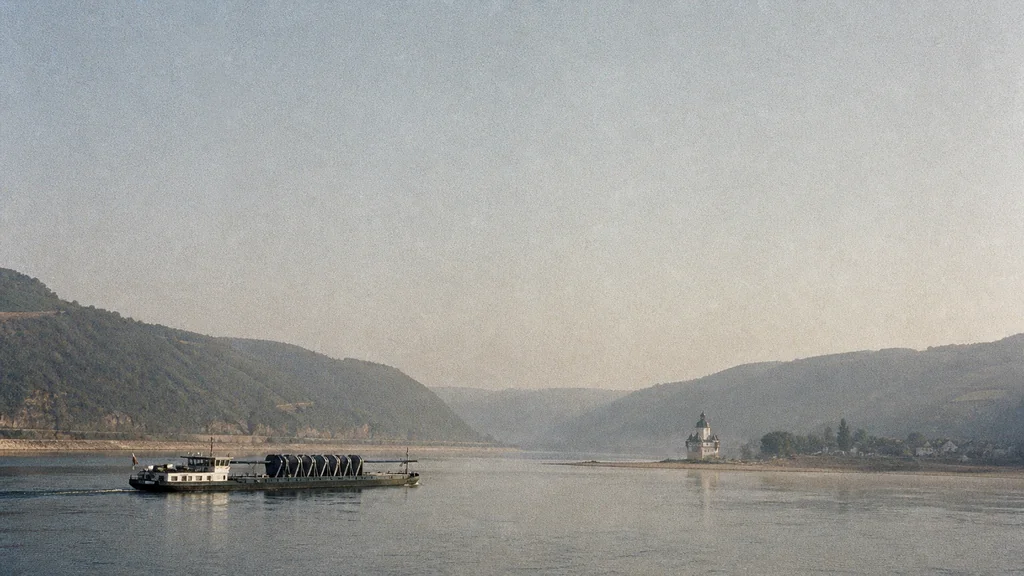
The Rhine still carries industry, but no longer at full weight.
Kompożizzjoni tal-immaġni · tobriefBASF has begun cutting output at Ludwigshafen, Europe’s largest integrated chemical site, because the Rhine is now too shallow to bring in enough raw materials by barge. On 17 August, the gauge at Kaub, the narrow Middle Rhine stretch between the North Sea ports and southern Germany’s industrial belt, read 5 centimetres, a new record low (Netz-Trends, ELWIS).
That number does not mean the river is only 5 centimetres deep. The riverbed sits below the gauge’s zero mark, so vessels can still pass. But the Kaub reading decides how much weight a barge can safely carry through one of Europe’s most important industrial arteries. At 5 centimetres, the answer is very little.
How shallow water breaks a chemical plant
Ludwigshafen runs as a Verbund, BASF’s term for an integrated system in which the byproduct or waste from one unit becomes the input for another. It is efficient when feedstocks move smoothly. It is exposed when one input is missing, because a cut in one unit can move quickly through the rest of the site.
The raw materials now in short supply arrive by barge: methanol, butane, propane and ammonia (BC Insight). A vessel that would normally carry about 1,200 tonnes is now loading roughly 350. That means fewer inputs per trip, higher costs per tonne, and a point at which trucks and trains cannot fill the gap.
FAZ reported that BASF had already throttled its first Ludwigshafen plants, without naming the units affected. Chief executive Markus Kamieth confirmed on 17 August that the company cannot fully meet delivery obligations for some products (Reuters).
The clearest sign is in BASF’s force majeure notices. These are legal declarations telling customers that an extraordinary event prevents the company from meeting its contracts in full. In mid-July, BASF declared force majeure on two plasticisers, chemicals used to make plastics flexible, at Ludwigshafen (ICIS). It also issued notices on surfactants, used in detergents and industrial cleaning, from other European sites, all citing Rhine logistics constraints (C&EN).
Who pays along the corridor
BASF is the largest name affected, but it is not alone. Covestro, which makes precursors for foams used in mattresses and refrigerators, declared force majeure at its Dormagen site on the Lower Rhine. The company said raw-material flows were "significantly restricted" and that road and rail could not fully make up the difference (MarketScreener, Reuters).
Barges still passing Kaub are carrying about 30-35% of their normal load, according to Dutch inland-shipping sources (Schuttevaer). The same cargo now needs more trips, and freight costs rise with each tonne carried. The bill moves down the chain to the firms buying what the barges transport.
In Belgium, construction companies reported surcharges of €17 per tonne on gravel, with barges needing four trips for a load that previously took one (Gazet van Antwerpen). For Malta, this is the part that matters beyond Germany. Industrial bottlenecks in the Rhine corridor do not stay local. They feed into prices and delivery times for chemicals, plastics and construction inputs across the single market.
Real damage, bounded damage
The IfW Kiel institute estimated that Rhine low water could cost €1-2 billion in lost value added in the third quarter. Value added means output generated by firms along the corridor, not retail sales. That would shave 0.1-0.2 percentage points off German GDP (Zeit).
German quarterly growth has been running near 0.2%, so even the lower end of that estimate would erase most of a quarter’s expansion. For a eurozone economy already moving slowly, a river gauge in one narrow stretch becomes a macroeconomic indicator.
Kamieth said the situation was less severe than the 2018 Rhine drought (Reuters). But the Kaub gauge did not fall as low as 5 centimetres in 2018 (Netz-Trends). The difference appears to be duration and spread: 2018 lasted longer and hit more widely, while this episode is sharper at the bottleneck but, so far, shorter.
The evidence is now specific. Rhine drought has moved from a transport problem to a production constraint for chemical firms on the river, especially between Kaub and Ludwigshafen. Trucks, trains and low-water barges can spread the shortage around. They cannot replace the capacity of a full barge.
Details about this article
- Model:
- claude-opus-4-6
- Generated:
- 8/18/2026, 1:55:37 AM
- Pipeline run:
- eu_pipeline_20260818_005006
- Watermark:
- SynthID (Google's invisible watermark)
- Human review:
- None before publication