Rosatom Stays Inside Europe’s Nuclear Chain
Europe closes Russian energy routes while leaving the nuclear passage open.
Kompożizzjoni tal-immaġni · tobriefA German nuclear fuel plant was cleared last month to make reactor components using Russian state technology. Berlin says it is against the project, but cannot stop it under the law as it stands. That is the uncomfortable gap in Europe’s sanctions regime: the EU has shut out Russian coal, most oil and much of its gas, while leaving civil nuclear trade largely untouched.
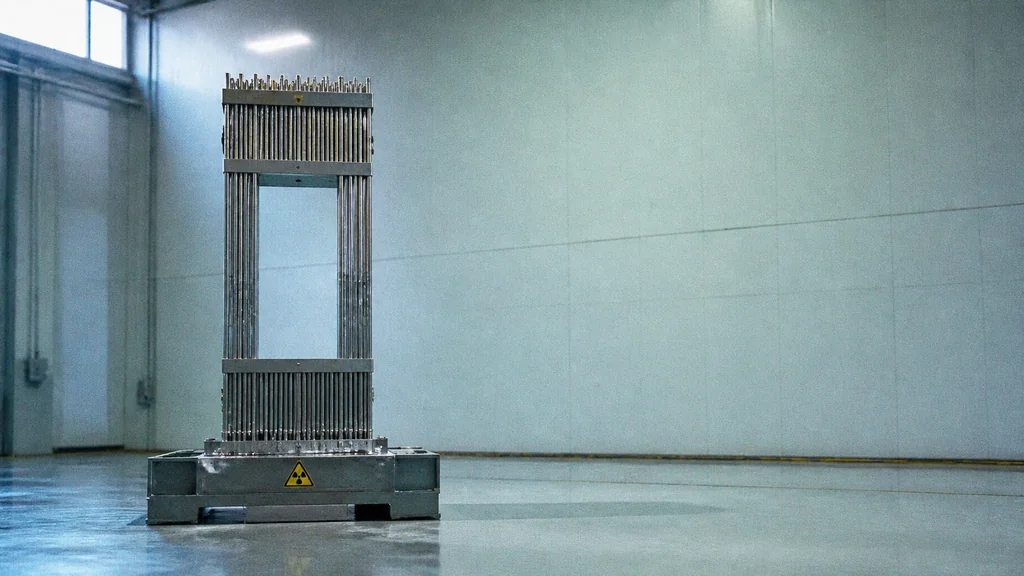
On 22 July, Lower Saxony approved an expansion at the fuel-element plant in Lingen, operated by a subsidiary of France’s Framatome. The new line will allow the plant to manufacture fuel assemblies for VVER reactors, a Soviet-designed model still used in Central and Eastern Europe (Framatome, BMUKN). The production depends on licences, technology and machinery from TVEL, the fuel arm of Rosatom, Russia’s state nuclear corporation.
Why Berlin Approved What It Opposes
Germany’s federal environment ministry said it had no legal basis to refuse the licence. German atomic law is built around safety, not foreign policy, and current EU sanctions do not cover civil nuclear cooperation (BMUKN). Lower Saxony’s environment minister Christian Meyer said Russian involvement was wrong, but that the state was acting under federal supervision and could not reject the application (NDR).
The approval came with security conditions: restrictions on Rosatom staff access, separation of IT systems and checks on hardware (ZEIT). Germany is not removing Russian involvement. It is trying to contain it.
For Malta, the point is familiar from other parts of EU regulation. When the EU leaves a loophole open, the practical question is not whether a government disapproves in public, but which legal instrument lets it act. In Lingen, that instrument is missing.
The EU has not closed the gap for two reasons: one technical, the other political.
Nuclear fuel is not traded like crude oil. A fuel assembly is a precision component built for a particular reactor, approved by a national regulator and inserted according to a fixed refuelling timetable. Framatome says 19 VVER reactors are operating in the EU (Framatome). Replacing Russian-origin fuel means new designs, test assemblies and plant-by-plant approval. That takes years.
The political obstacle is more direct. EU sanctions require unanimity under Article 31 of the EU Treaty (EUR-Lex). One government can block the package. Hungary’s foreign minister Péter Szijjártó has said nuclear sanctions would threaten Budapest’s Paks II expansion, a Rosatom-led project backed by a Russian state loan of up to €10 billion (Agenzia Nova, World Nuclear Association).
Where the Real Dependency Sits
Russia’s strongest hold is not in raw uranium, but in the processing chain. According to the Euratom Supply Agency, Russia supplied about 15.6% of the EU’s natural uranium in 2024. Its share was higher in the harder-to-replace stages: roughly 22.4% of conversion services, which turn uranium ore into gas suitable for enrichment, and 23.5% of enrichment services, which concentrate the fissile material needed to power a reactor (Euratom Supply Agency, S&P Global). Only a small number of facilities worldwide can do this work at scale.
The countries running VVER reactors now fall into three groups. Czechia and Bulgaria are already moving away: Temelin received its last TVEL delivery at the end of 2024, and Kozloduy’s Unit 5 is loading Westinghouse fuel (Seznam Zprávy, Sega).
Slovakia has signed Western fuel contracts, but they are not yet fully implemented across all five reactors. Nuclear power provides about 62% of its electricity, which leaves little room for disruption (Reuters, World Nuclear Association). Hungary has not yet licensed any Western fuel for Paks; Framatome’s first alternative assemblies are expected around 2028 (Atlatszo).
France complicates the picture from the supplier side. Reuters reported that France imported 39% of its enriched uranium from Russia in 2025 (Reuters). Orano, France’s fuel-cycle company, prefers declining quotas rather than an abrupt break, while Framatome stands to gain VVER fuel contracts through the Lingen expansion. Paris is pushing diversification while its companies benefit from the present arrangement.
The Economic Case for Deadlines
The United States has already taken a middle route. Washington banned Russian uranium imports in 2024, while allowing temporary waivers where alternatives are not yet available (Congress). The EU has not put forward an equivalent proposal, despite its REPowerEU pledge to end dependence on Russian energy (European Commission).
The winners from a phased EU exit would be clear. Westinghouse, Framatome and European enrichment capacity linked to Urenco would gain contracts and a firmer basis for investment. Uncertainty over EU action is already delaying spending decisions at Urenco (Reuters). Rosatom would lose revenue. Budapest would lose leverage.
For a small member state such as Malta, which has no nuclear sector but lives with the consequences of EU energy prices and sanctions policy, the issue is less remote than it looks. EU rules become domestic reality quickly here, whether in electricity costs, compliance burdens or the credibility of common foreign policy.
An immediate blanket ban would be careless, because some reactors cannot yet run on non-Russian fuel. No ban at all leaves Rosatom embedded in European energy infrastructure for another decade. The workable route is binding deadlines tied to each reactor’s ability to switch, with waivers only where alternatives genuinely do not exist. Without that, Europe will keep sanctioning Russian energy while licensing Russian nuclear cooperation at the same time.
Details about this article
- Model:
- claude-opus-4-6
- Generated:
- 8/25/2026, 2:07:43 AM
- Pipeline run:
- eu_pipeline_20260825_005008
- Watermark:
- SynthID (Google's invisible watermark)
- Human review:
- None before publication