Russian Oil Cap Nears $58
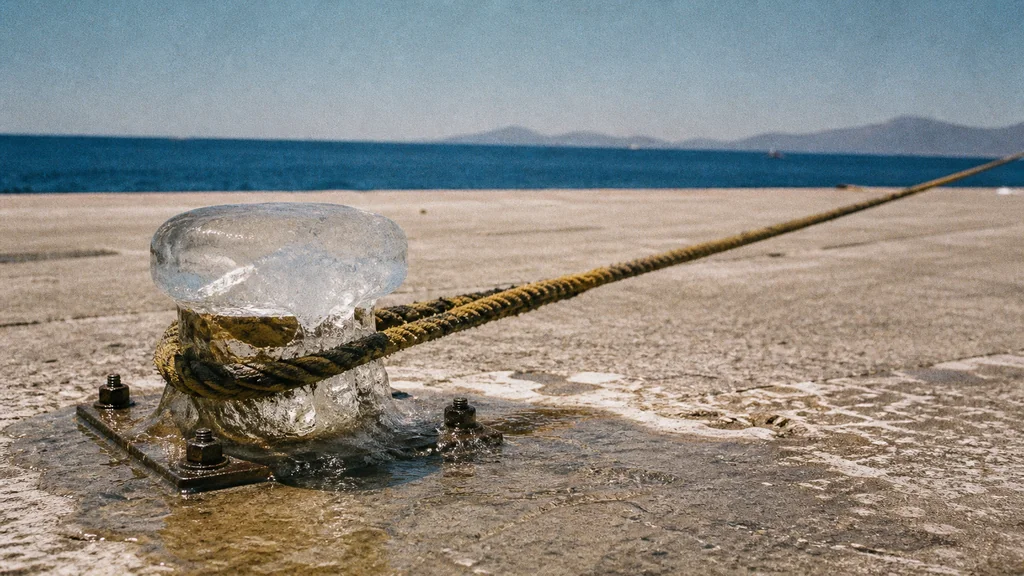
The frozen diplomacy of the oil cap melts under the heat of Mediterranean shipping interests.
Kompożizzjoni tal-immaġni · tobriefJuly 15. The EU's price cap on Russian oil was due to recalculate automatically today. Unless all member states agreed to freeze it, the ceiling risked moving from $44.10 to roughly $58 a barrel, weakening one of Europe's main instruments for cutting Moscow's oil income (Euronews, World Oil). As of last night, EU ambassadors were still negotiating. No agreement had been announced.
The cap, agreed in December 2022 by the EU, G7 and allies, does not block Russian oil from physically reaching buyers. It works through the plumbing of global trade: Western shipping companies, insurers, brokers and banks may handle Russian crude only if it is sold at or below the ceiling (Council of the EU). Raise the ceiling and the sanction loses force. A cargo priced at $55 breaches a $44.10 cap but passes under a $58 one. The same barrel, the same insurer, becomes legal overnight.
The formula is recalculated every six months using recent average prices for Urals crude, Russia's main export blend. Urals rose to $125 in April before falling to $51 by early July (EIA, Bruegel). A formula looking backwards can therefore lock in a generous cap just as the market is cooling.
The shipping states that resisted
The clearest resistance to freezing the cap came from Greece, Cyprus and Malta. Their shipping sectors earn substantial revenue from the legal transport of Russian crude. By one estimate, Greek shipping firms made at least $3.8 billion from Russian oil transport since July 2023 and carried nearly 15% of Russian crude exports in May (Strategist).
For Malta, this is not a distant sanctions argument. The island's maritime registry and services sector sit directly inside the mechanism the EU is trying to use. Valletta, Athens and Nicosia argued that if the EU tightened the cap while the US stayed at $60, shipping and insurance work would shift to non-European operators without reducing Russian exports (DW). The argument is not empty. It also shields commercial positions worth billions.
Hungary and Slovakia came at the issue from another angle, tied to MOL, the refiner processing crude that still arrives through the Druzhba pipeline, the Soviet-era network carrying Russian oil into Central Europe. MOL used 88% Russian oil in the first eleven months of 2025, yet Hungarian pre-tax fuel prices were higher than in neighbouring Czechia (24.hu, Euronews Hungary). Cheap Russian crude went in. Cheap petrol did not come out. The discount ended up in MOL's margin, the gap between what it pays for oil and what it charges for fuel, rather than with Hungarian drivers.
The real weakness is who checks the paperwork
Whether the cap remains at $44.10 or rises matters less if enforcement is weak. CREA, the Centre for Research on Energy and Clean Air, estimated that strict enforcement at $44.10 would have cut Russia's June oil revenue by roughly €5 billion, or 36% (CREA). That difference between a cap written into sanctions law and a cap that actually changes shipping behaviour is where the money for the war keeps moving.
The leaks are not theoretical. CREA found eight cargoes of Russian-origin products reaching EU ports in June and €149 million worth of Russian oil transferred between ships in EU waters (CREA). The EU has listed 632 shadow-fleet vessels, tankers operating outside normal insurance and registration systems to move sanctioned oil, but there is still no full ban on providing maritime services to them (UK Defence Club).
This may be the moment when the cap can do more damage. KSE Institute found that a shortage of shadow tankers has increased Russia's dependence on Western maritime services, which means the mechanism could bite harder now than at any point since it began (KSE Institute). The European Commission has also confirmed that EU fuel supply remains stable (European Commission).
A frozen cap only matters if European insurers, port authorities and shipping firms are made to prove that the oil really traded below it.
Details about this article
- Model:
- claude-opus-4-6
- Generated:
- 7/15/2026, 2:18:42 AM
- Pipeline run:
- eu_pipeline_20260715_005006
- Watermark:
- SynthID (Google's invisible watermark)
- Human review:
- None before publication