Barges Keep Cernavodă Running
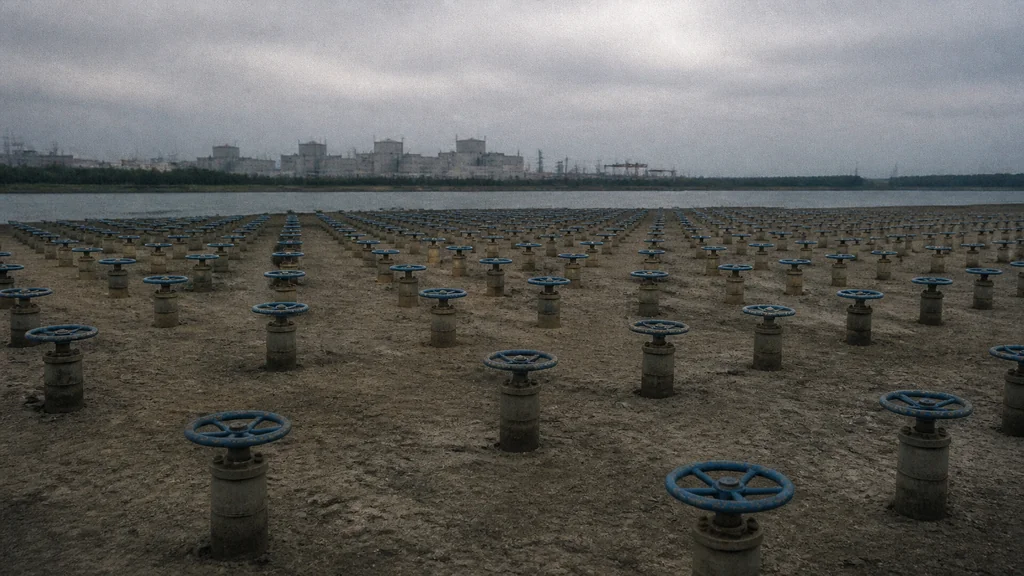
A shrinking river leaves an entire power system waiting for water.
Kompożizzjoni tal-immaġni · tobriefFour barges filled with rock are now sitting on the bed of the Danube, sunk on purpose to push more water towards Cernavodă, Romania's only operating nuclear power station. The makeshift barrier raised the cooling-intake level by 8 centimetres above forecast, enough to keep Unit 2 running for at least another nine days (Digi24, HotNews). As we reported Thursday, Bucharest had already warned the European Commission that drought was putting Cernavodă at risk. A state secretary in the Transport Ministry has since cautioned that the Danube's currents could be strong enough to shift the barges out of place (Știrile ProTV). The emergency fix is holding, but only just.
Why a river level is a power crisis
A nuclear plant is, in practical terms, a very large heat system. Fission produces heat, heat turns water into steam, steam drives a turbine, and that steam then has to be cooled back into water. At Cernavodă, the Danube provides that cooling. If the river falls too low, the pumps cannot draw enough water, and operators have to shut the reactor before safety margins are breached.
The problem was made worse by the Bala branch, a shortcut channel pulling about 85% of the local Danube flow away from the route feeding the plant's pumps (Mediafax). Romania's water authority blasted a submerged rock formation, dredged the channel, and then sank the four stone-filled barges to narrow the Bala entrance and force more water towards Cernavodă (Agerpres, AP). Barges were chosen because they could be deployed in days. Proper structural works cannot.
At Romania's entry point, the Danube was flowing at about 1,400 cubic metres per second, roughly a third of the August average of 3,900. Hydrologists expected it to fall further, below any August minimum previously recorded (Radio România, Agerpres).
Cernavodă normally supplies around 20% of Romania's electricity (World Nuclear Association). With Unit 1 already shut since 28 July, the loss of Unit 2 would remove roughly 650–680 MW from the grid. That has already changed Romania from power exporter to importer: according to Serbia Energy, the next day's wholesale electricity price reached €132.87 per MWh, while the country needed about 1,700 MW of evening imports (Serbia Energy). Nuclearelectrica also warned clients of possible force majeure, meaning a legal notice that it may not be able to honour its delivery contracts (ZF).
Shared river, uneven stress
The same drought is tightening conditions across the Danube basin, but not evenly. Hungary's Paks nuclear plant cut output by 1,770 MW, leaving it producing around 230 MW from a normal capacity close to 2,000 (kormany.hu). Once Hungary's own nuclear backstop weakened, it turned to neighbours, covering much of the gap with Czech-origin electricity routed through Slovakia.
Slovakia was under pressure too. Seven of the eight turbines at its Gabčíkovo hydropower dam were idled by low water, and Bratislava refused Budapest's request for more flow, saying it was already releasing what the Hague treaty required (TA3, Noviny.sk).
Bulgaria, for now, is the winner. Kozloduy's nuclear plant kept running because its inland pumping station gives it a water margin that Paks and Cernavodă do not have. Bulgarian exports rose to 32,000–33,000 MWh per day as Romanian and Hungarian traders chased cross-border capacity (Mediapool). The European Commission said it was monitoring the situation through ENTSO-E, the body that coordinates Europe's electricity grids, but did not yet see a supply threat requiring formal intervention (European Commission).
Emergency engineering is not adaptation
France's EDF has set aside almost €9 billion over 15 years to climate-proof its nuclear fleet, expecting heat and low river flows to cost about 5 TWh a year by 2050 without investment (Le Monde). Cooling towers avoid the river-intake problem altogether; the Czech plants at Dukovany and Temelín already use them (World Nuclear Association).
The four barges have bought Romania a few days. They have not answered the larger question facing every Danube-basin government: how to run river-cooled power systems when the river itself can no longer be treated as a fixed assumption.
Details about this article
- Model:
- claude-opus-4-6
- Generated:
- 8/10/2026, 2:15:27 AM
- Pipeline run:
- eu_pipeline_20260810_005005
- Watermark:
- SynthID (Google's invisible watermark)
- Human review:
- None before publication