Romania’s €2.84bn claim hits conditions
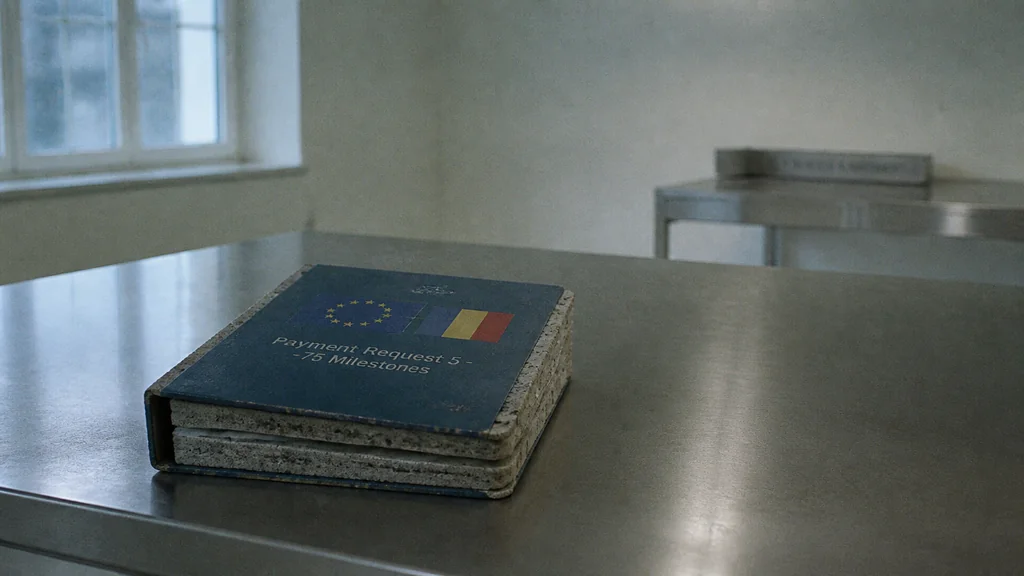
Romania’s claim hardens into proof before Brussels releases the money.
Kompożizzjoni tal-immaġni · tobriefRomania filed its fifth payment request under the EU's Recovery and Resilience Facility on Friday, asking Brussels for €2.84 billion tied to 75 milestones and targets (Digi24, Agerpres). For Maltese readers used to EU funds being treated as domestic policy rather than foreign help, the distinction matters: this is a claim, not money in the bank. Minister Dragoș Pîslaru's own figures put the likely net cash at about €2.08 billion — €1.65 billion in grants and €433 million in loans — once pre-financing already paid to Romania is deducted (Mediafax, Stirile ProTV).
Even that lower sum depends on whether the European Commission accepts that Bucharest has delivered the reforms it promised. The RRF — the EU's post-pandemic recovery fund, financed through hundreds of billions in joint borrowing — pays member states after delivery, not on request (EUR-Lex). Romania has now made the request. The evidence is the real test.
Two months to check 75 boxes
The Commission has roughly two months to examine Romania's file. Senior finance officials from the member states then have four weeks to give their view before any payment is released (EUR-Lex, IEU Monitoring). The Romanian government wants the money within 2026. That leaves little room for delay.
Commission guidance says all milestones must be completed by 31 August 2026, final requests filed by the end of September, and all payments made by December (Commission closing guidance). If Brussels finds gaps, it can suspend part of the payment while releasing the rest. Spain's sixth request showed the mechanism in practice: Madrid received €6.234 billion after 73 milestones were verified, while three objectives remained pending because the evidence was not complete (RTVE, La Moncloa).
Brussels rarely turns such requests into a clean yes-or-no decision. It checks the boxes, withholds the pieces that are not yet proven, and pays them when the missing evidence arrives.
Coal closures and salary politics
Two parts of Romania's request are exposed. The first concerns coal and decarbonisation. On 6 August, the Commission said it would review amendments passed by Romania's parliament to the country's decarbonisation law. Those changes could weaken the commitment to retire 710 MW of coal power capacity, a milestone Brussels had already considered fulfilled (Agerpres).
The second is the public-sector salary law. Romania's coalition parties have not agreed on wage ceilings, and the law must pass by 31 August. That deadlock puts around €771 million in grants at risk (Romania Insider, Antena 3). As we reported three weeks ago, the salary law was already the reform in Romania's plan carrying the heaviest political risk.
This is familiar EU territory for Malta too: Brussels does not only fund infrastructure; it uses payment schedules to force reforms that national coalitions would rather postpone. The leverage sits in the calendar.
Who pays if Brussels holds back
If the request is approved in full, Romania receives EU grant money it does not have to repay. If part of the payment is suspended, Bucharest must cover the gap by borrowing, delaying projects, or cutting spending. According to ZF, Romanian government bond yields are already above 6.7%, so replacing free EU grants with market debt is costly.
Full approval would raise Romania's received grant share to about 78% of its total €13.57 billion RRF allocation, from 66% today (ZF, Mediafax). If Brussels suspends money, the losers are taxpayers paying for dearer borrowing and communities waiting for the hospitals and roads those grants were meant to finance.
For the wider EU, including Malta, the point is bigger than one Romanian payment file. The RRF was funded by debt borrowed in the name of all member states (Council). Whether the pay-after-delivery model survives deadline pressure matters to every country standing behind that debt. Romania has not unlocked €2.84 billion. It has handed Brussels a file, and the Commission's assessment, expected around October, will decide what that file is worth.
Details about this article
- Model:
- claude-opus-4-6
- Generated:
- 8/16/2026, 1:58:05 AM
- Pipeline run:
- eu_pipeline_20260816_005006
- Watermark:
- SynthID (Google's invisible watermark)
- Human review:
- None before publication