Turkey Pushes Parks Into Disputed Waters
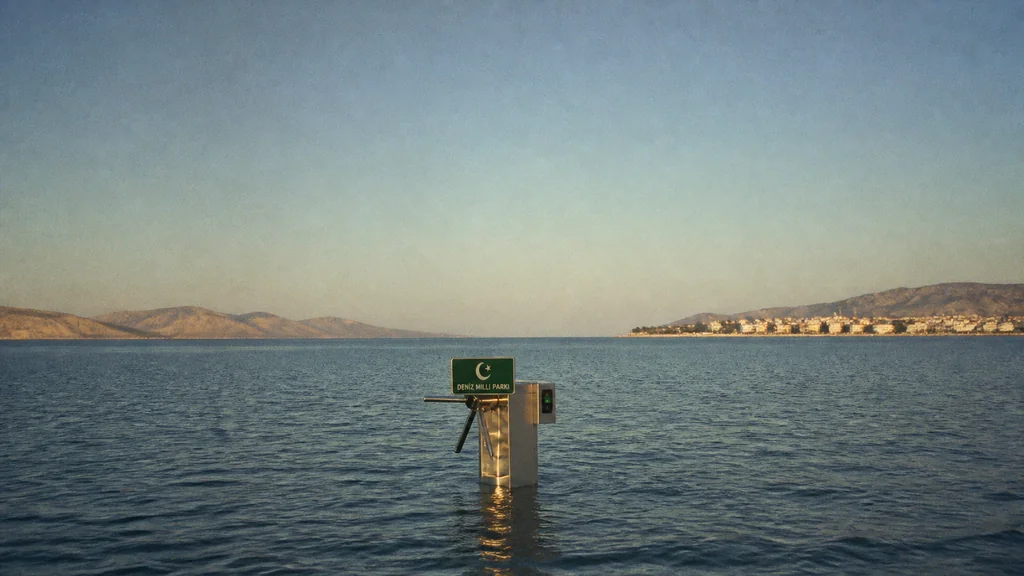
A conservation decree waits to become a checkpoint at sea.
Kompożizzjoni tal-immaġni · tobriefTwo presidential decrees published on Saturday have turned large stretches of sea near Greek islands into Turkish national parks. A marine park does not create sovereignty under international law. The issue is whether Ankara will use conservation rules, permits and patrols to create practical control before any maritime boundary is agreed.
Two parks, two pressure points
President Recep Tayyip Erdogan signed decrees establishing two marine national parks. The first, the Fethiye-Kaş Marine National Park, lies between Turkey's south-western coast and waters close to the Greek islands of Kastellorizo and Rhodes. The second, the North Aegean Marine National Park, covers about 1,742 km² off the Turkish coast near Lemnos and Samothrace (BloombergHT, Harita Haber).
Both were published in Turkey's Official Gazette on 16 August, with coordinate annexes and boundary maps (Hürriyet). This matters because they are not political remarks for domestic television. They are legal acts under Turkish law. They give the areas conservation status, draw boundaries and create the basis for permits, patrols and restrictions. That is normal where a state already has jurisdiction. The fight is over where Turkish jurisdiction stops.
Greece says the parks go beyond Turkish territorial waters, the belt of sea where a coastal state has sovereignty, normally up to 12 nautical miles. Athens argues that the decrees reach into areas where Greece has continental-shelf rights over the seabed and its resources. The Greek foreign ministry called the decrees illegal and said they "create no fait accompli" (Kathimerini, ProtoThema).
Turkey's case has been carried mainly through semi-official media rather than a verified foreign ministry statement. The line is that the parks protect Turkish maritime rights (Daily Sabah).
The cartographic logic
The geography follows a familiar Turkish argument: Greek islands close to the Turkish coast should produce little or no maritime zone of their own. In the south, the Fethiye-Kaş corridor echoes the logic of the 2019 Turkey-Libya maritime deal, which drew Turkish and Libyan claims across waters that Greece says are affected by its islands. Athens has spent three rounds of Greece-Libya talks trying to neutralise that agreement (To Brief).
In the north, a Turkish administrative zone between Lemnos and Samothrace amounts to a claim to manage waters Greece regards as its continental shelf or open sea (Kathimerini).
The annexed coordinates have not yet been independently plotted, so the exact overlap cannot be confirmed. The broad picture is clear enough. Both parks sit where Greek and Turkish claims collide.
Continental-shelf rights are not created by the newest map in an official gazette. The International Court of Justice held in the North Sea Continental Shelf case that such rights exist automatically because of a state's coastline, not because of later administrative acts (ICJ). Turkey is not a party to UNCLOS, the UN Convention on the Law of the Sea, but many of its core rules are treated as customary international law, meaning they bind states even outside the treaty framework (UNCLOS).
A conservation label cannot override that. A marine park can regulate fishing and require permits where the state already has authority. It cannot create authority in waters where that authority does not exist.
Greece alone, Europe quiet
As of publication, no other EU government has publicly responded to the decrees. France has offered only an indirect signal: Le Figaro and Opex360 reported an increase this month in Turkish drone and aircraft violations of Greek airspace, placing the parks within a wider pattern of pressure in the Aegean (Le Figaro, Opex360).
That silence is not neutral. The parks touch the claimed continental shelf of an EU member state and the bloc's external maritime border. For Malta, a small island state whose economy and security depend on law-of-the-sea rules being more than polite theory, the point is familiar. Maritime law is domestic policy when your jurisdiction is mostly sea.
Athens says it will raise the issue at EU and NATO level. Neither forum can settle the boundary. The EU can make political statements and apply diplomatic pressure. NATO can manage tensions between two allies. Neither can draw the legal line on a chart.
The real test comes when Turkey applies the decrees. If Ankara starts issuing permits, sending patrols or requiring authorisation from vessels in waters that international law places outside Turkish control, the parks will no longer be just conservation designations. They will become rules that ships and officials are expected to obey.
For now, Greece is treating the matter as a European border issue. The rest of Europe is allowing it to remain a Greek-Turkish dispute.
Details about this article
- Model:
- claude-opus-4-6
- Generated:
- 8/17/2026, 1:57:59 AM
- Pipeline run:
- eu_pipeline_20260817_005006
- Watermark:
- SynthID (Google's invisible watermark)
- Human review:
- None before publication